
Main Content
Bus Service Inaugurated at Habiganj Agricultural University to Facilitate Student Transportation
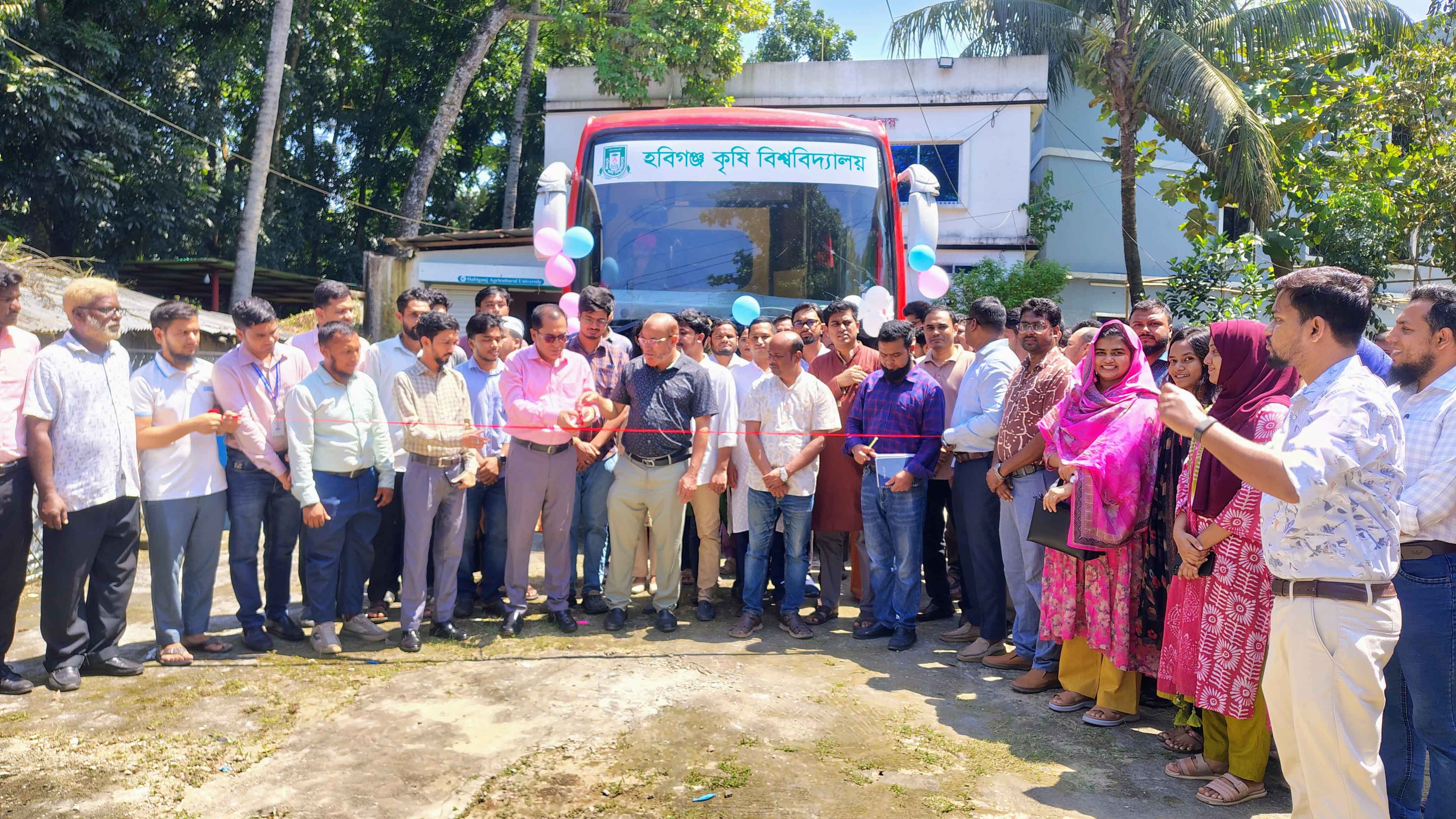
Bus Service Inaugurated at Habiganj Agricultural University to Facilitate Student Transportation
For the first time, Habiganj Agricultural University (HAU) has introduced bus services to make transportation easier and safer for its students. With the addition of two single-decker buses from the Bangladesh Road Transport Corporation (BRTC), the university’s transportation facilities have been further expanded to support students’ regular commuting.
On Tuesday (15 September), the bus service was inaugurated on the university campus by Vice-Chancellor Professor Dr. Md. Mozammel Hoque. Present on the occasion were Pro-Vice-Chancellor
Professor Dr. Mohammad Ismail Hossain, Assistant Student Affairs Adviser (In-Charge) and Assistant Controller of Examinations (In-Charge) Dr. Jakaria Chowdhury Onik, Assistant Proctor (In-Charge) Tukir Ahamed, and teachers, students, officers, and employees from various departments of the university.
Vice-Chancellor Professor Dr. Md. Mozammel Hoque said, “The introduction of the bus service is expected to ensure a safer and more comfortable commuting environment for students travelling to and from the university campus. At the same time, this initiative will pave the way for further expansion and modernization of the university’s transportation system in the future”.
It may be mentioned that the university currently conducts its academic activities with 173 male and 196 female students across five academic years. The two buses will operate regularly at scheduled times between the university campus and Habiganj city, as well as between the campus and the temporary female residential hall located in Dhuliyakal and the temporary male residential hall located in Poddar Bari. In addition, the buses will be available for educational tours and field visits organized by various faculties of the university. This facility is expected to further enhance and strengthen the students’ practical learning experiences.


