
Main Content
Workshop Held at HAU to Ensure Accreditation and Quality in Higher Education
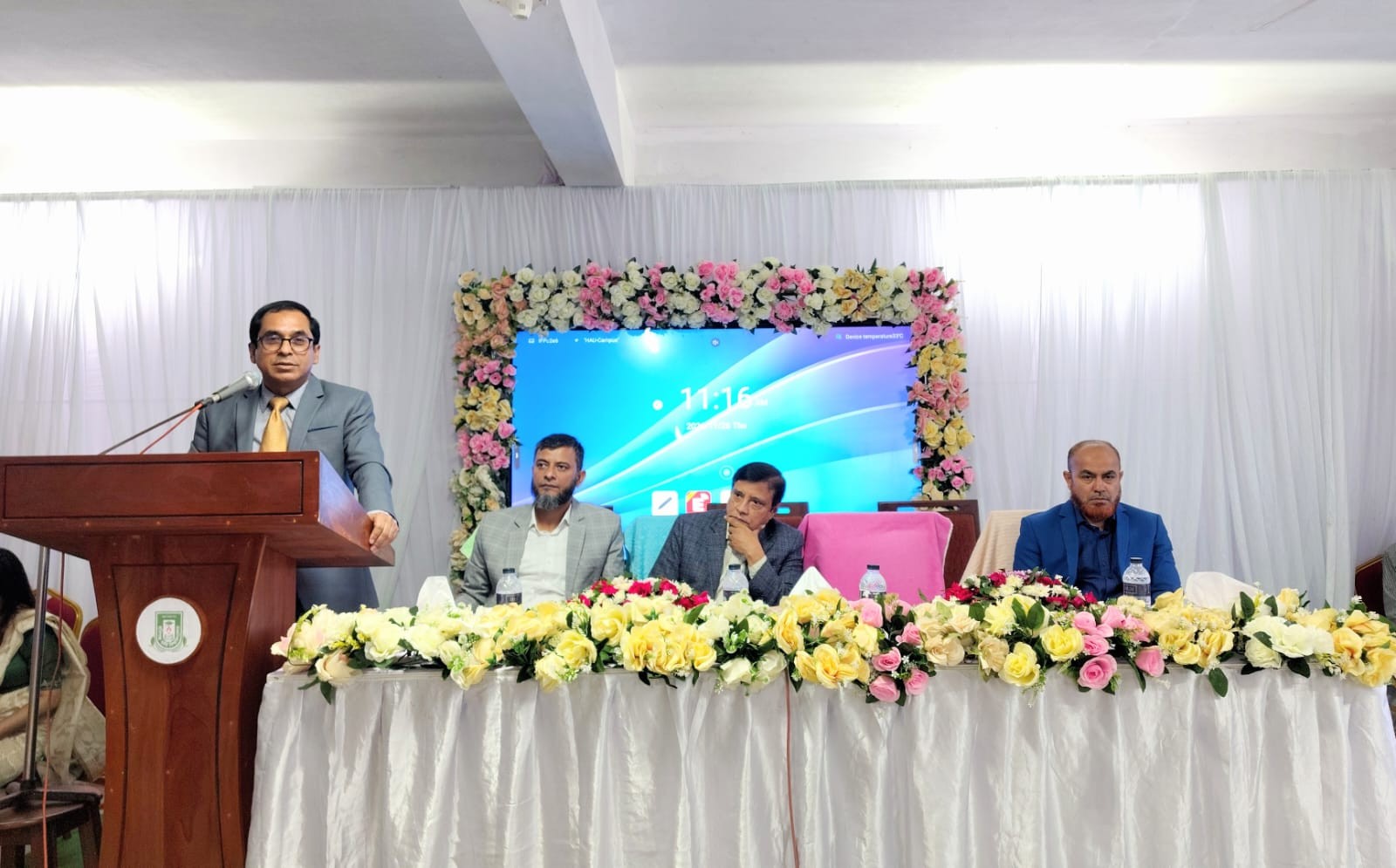
Workshop Held at HAU to Ensure Accreditation and Quality in Higher Education
A day-long workshop titled “Institutional Gap Analysis, Accreditation Standards and Strategic Action Plan” was held at the Academic and Administrative Building (T. R. Palace) of Habiganj Agricultural University (HAU) at 9:30 AM on Thursday (November 26), organized by the university’s Institutional Quality Assurance Cell (IQAC). The workshop aimed to enhance teachers’ knowledge and skills regarding quality assurance in higher education, institutional capacity assessment, and accreditation processes. Teachers from all faculties of the university participated in the day-long event.
The workshop was chaired by the Vice-Chancellor of the university, Professor Dr. Md. Mozammel Hoque. Professor Dr. Md. Shah Imran, Full-Time Member of the Bangladesh Accreditation Council (Accreditation and QA & NQF), attended as the Chief Guest. Professor Dr. Mohammad Ismail Hossain, Pro-Vice-Chancellor of the university, was present as the Special Guest. The keynote paper was presented by Professor Dr. Md. Wakilur Rahman, Full-Time Member of the Bangladesh Accreditation Council (Council, Research and Publications).
In his presidential address, Vice-Chancellor Professor Dr. Md. Mozammel Haque said that accreditation is not merely a formal recognition; rather, it is a continuous process of improving the quality of education, research environment, institutional management, and overall capacity. He emphasized that all concerned, including teachers, must play their respective roles with responsibility to establish Habiganj Agricultural University as a quality-driven and internationally competitive higher education institution. He expressed hope that such workshops would enrich teachers’ knowledge and experience while contributing effectively to the overall improvement of the university’s quality.
The workshop featured discussions and guidance on identifying existing institutional gaps and limitations, gaining a clear understanding of accreditation standards, and developing practical strategic action plans to improve the overall quality of the university. Participants also exchanged views and experiences during the open discussion and question-and-answer sessions. As part of the workshop, separate consultation sessions were held with students of the Modular Semester Programs of the 2024–2025 and 2025–2026 academic sessions. During these sessions, students shared their views on academic activities, academic facilities, existing problems, and various limitations.
It is expected that the workshop will play an important role in improving academic activities, strengthening institutional capacity, and ensuring the quality of higher education in alignment with national and international standards.


